When you buy through links on our articles, Future and its syndication partners may earn a commission.

For the first time in more than 50 years, humans are cruising through lunar space.
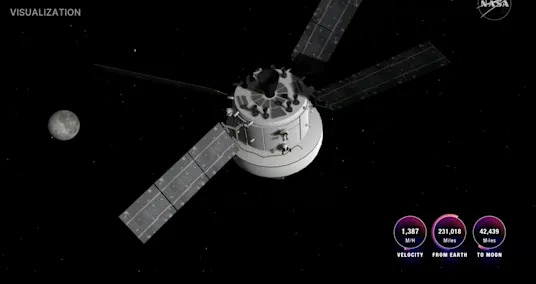
The four astronauts of NASA's Artemis 2 mission arrived in the moon's sphere of influence — the region where lunar gravity exerts a more powerful pull than that of Earth — today (April 6) at 12:37 a.m. EDT (0437 GMT).
The milestone occurred when the mission's Orion capsule was about 39,000 miles (62,764 kilometers) from the moon and roughly 232,000 miles (373,368 km) from Earth, a commentator said during NASA's Artemis 2 livestream.
The Artemis 2 astronauts — NASA's Reid Wiseman, Victor Glover and Christina Koch and the Canadian Space Agency's Jeremy Hansen — are the first people to cross the lunar threshold since December 1972, when the three-person Apollo 17 moon-landing mission did so.
Artemis 2 will not touch down on the moon, or even enter lunar orbit. Rather, Orion will loop around the moon's far side this evening in a history-making flyby. During that encounter, Artemis 2 will get farther from Earth than any crewed flight ever has.
The distance record is currently held by the Apollo 13 astronauts, who got 248,655 miles (400,171 km) from our planet in April 1970. At the height of tonight's flyby, just after 7 p.m. EDT (2300 GMT), Artemis 2 will be 252,757 miles (406,773 km) away from the rest of humanity, NASA officials have said.
The Artemis 2 astronauts will study the moon during the flyby, gathering data that could help scientists better understand the terrain and geology of Earth's nearest neighbor. They'll also be treated to a total solar eclipse, which will not be visible to those of us here on terra firma.
In addition, the flyby will chart their path home: Lunar gravity will slingshot Orion back toward Earth. Artemis 2 astronauts will come home on Friday (April 10), ending their 10-day mission with a parachute-aided splashdown off the coast of San Diego.
Editor's note: This story was updated at 1:15 a.m. EDT on April 6 with NASA's revised time of Orion's entry into the moon's sphere of influence — 12:37 a.m. EDT rather than 12:41 a.m. EDT.
latest_posts
- 1
 Iranian president warns of retaliation against Gulf states
 - 2Where You Could Sleep With Snorlax in Japan, From MIMARU’s Pokémon Rooms to Grand Hyatt Tokyo’s Limited Pokémon Suite
- 3Deadly heat worldwide prompts $300 million for climate health research at COP30
- 4Tasting America: An Excursion Through Darling Cheap Food Brands
- 5Dutch police probe a small blast outside a pro-Israel Christian center




- Americans generally like wolves − except when we’re reminded of our politics
- FBI arrests Brian Cole Jr. in Jan. 6 pipe bomb investigation, ending 5-year hunt
- Arctic sea ice hits lowest winter level as unprecedented heat hits smashes records all over Earth
- My skin feels drier, my lips thinner and my makeup heavier. How do I adjust my routine for aging skin?
- Explainer-What Novo Nordisk's weight-loss pill approval means for company, patients
- Discovery off Israel’s coast reveals earliest known 2,600-year-old shipment of raw iron
- Whale stranded off Germany for days is stuck again
- NASA says Maven spacecraft that was orbiting Mars has gone silent
- Burger King launches 'SpongeBob' menu ahead of film's release. A look at the Bikini Bottom-inspired meal, plus what taste testers are saying.